
Hidden Solar Maintenance Costs: What Salesmen Won't Say
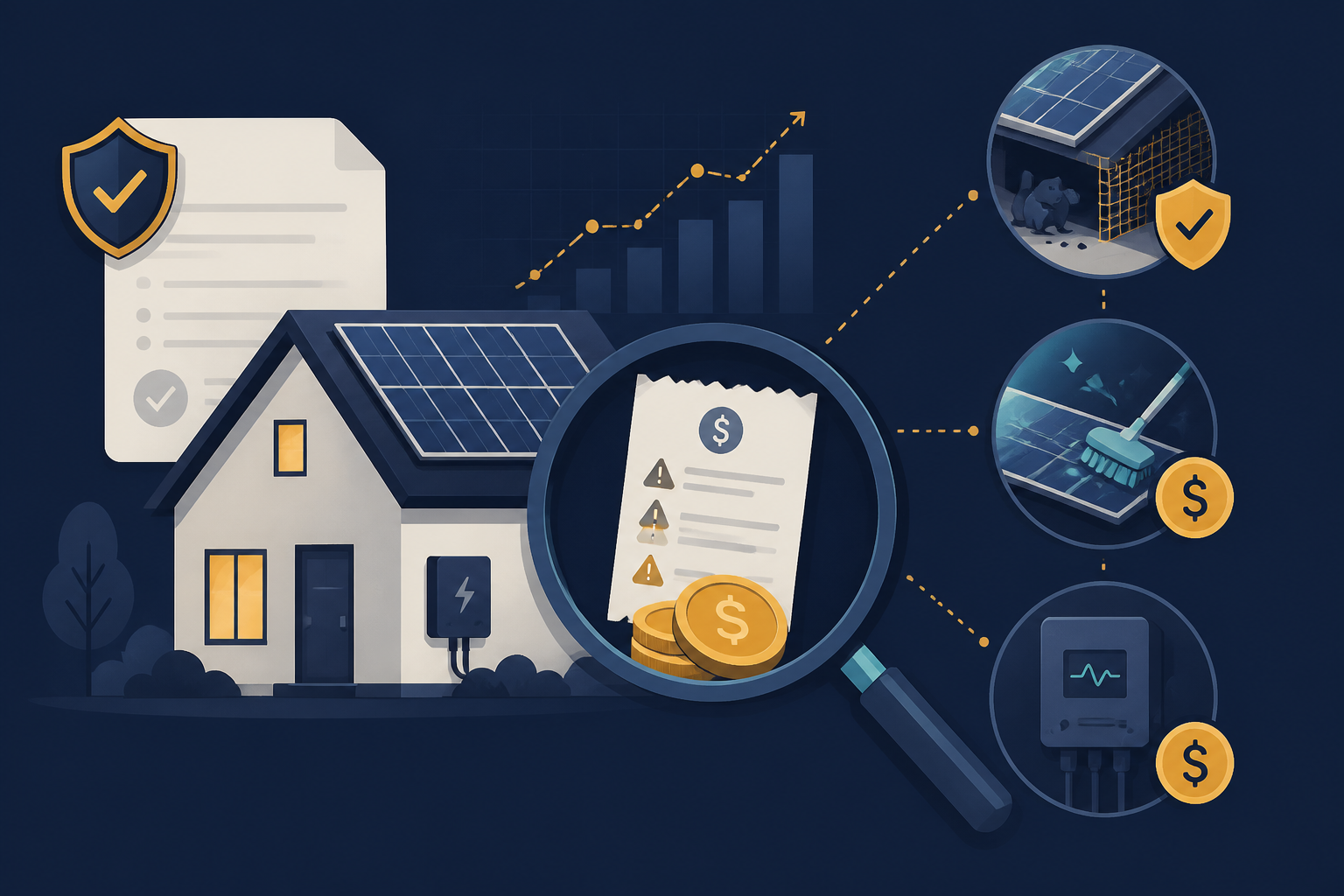
Solar is advertised as 'maintenance free,' but hidden costs like pest proofing and professional cleaning can add up. Here is what your installer won't tell you.
Hidden Solar Maintenance Costs: What Your Salesman Didn’t Say
Most homeowners are sold on solar panels with a single, seductive promise: “Once they’re on the roof, you can just forget about them.” While it is true that solar PV systems have no moving parts, the idea that they are 100% maintenance-free is a myth.
If you want your system to last 25 years, you need to account for the real solar operations and maintenance cost. While your 25-year equipment warranty covers factory defects, it won't cover bird nests, grime, or electrical wear and tear.
The Professional Cleaning Reality
Salespeople often tell homeowners that rain will wash their panels for free. While rain helps, it is rarely enough to remove “impacted” debris like bird droppings, pollen, and industrial dust. Over time, this layer of grime creates a film that blocks sunlight, potentially reducing your energy production by 5% to 20%.
Professional cleaning typically costs between $150 and $350 per visit, depending on the size of your array and the pitch of your roof. For most US homeowners, an annual or bi-annual cleaning is necessary to maintain the ROI (Return on Investment) promised during the sales pitch. This is a recurring solar operations and maintenance cost that rarely appears on a financing contract.
The Pigeon Problem: Critter Guarding
One of the most common “hidden” expenses is avian management. Pigeons and squirrels love the shaded, protected area underneath solar panels. If they move in, they bring corrosive droppings and nesting materials that can cause fire hazards or structural damage.
Standard warranties do not cover damage caused by animals. To prevent this, you need “critter guards”—a wire mesh installed around the perimeter of the panels. This can cost anywhere from $500 to $1,500, depending on the linear footage of your array. If your salesperson didn't include this in your initial quote, you’ll likely be paying for it out of pocket once the first nesting season begins.
The Inverter Replacement Gap
While solar panels are usually warrantied for 25 years, the “brain” of the system—the inverter—usually isn't. Most string inverters are warrantied for 10 to 12 years. This means that at some point during the life of your 20-year solar loan, you will likely need to replace the inverter.
Replacing a central string inverter can cost $1,500 to $3,000, including labor. If you have microinverters (one under each panel), they tend to last longer, but if one fails, the labor cost to remove the panel and swap the unit can still be significant. Factoring a future inverter swap into your long-term solar operations and maintenance cost is essential for accurate budgeting.
Monitoring and Annual Inspections
Your solar app might show you how much power you are producing, but it won’t tell you if a mounting bolt is loosening or if a wire is fraying due to wind. A professional O&M (Operations and Maintenance) inspection once every 3–5 years is highly recommended.
An electrician or solar technician will check for terminal torque, thermal hotspots, and grounding continuity. These inspections usually cost $200 to $400. Catching a loose connection early can prevent a system-wide failure or, in extreme cases, a roof fire.
Roof Repairs and Panel Detach/Reset
If your roof develops a leak or needs replacement before your panels reach the end of their life, you face a major expense. You cannot simply shingle around solar panels. A solar crew must come to “detach and reset” the system.
This process involves documenting the system, removing the panels, storing them safely, and re-installing them once the roof work is done. Expect to pay between $2,000 and $5,000 for this service. This is why experts always recommend installing solar on a roof that has at least 15–20 years of life left.
Bottom Line
Solar is still one of the best home improvements for long-term savings, but it isn't a "set it and forget it" technology. By budgeting roughly $150 to $300 per year for your average solar operations and maintenance cost, you can ensure your system actually hits that 25-year milestone. Don’t let a salesperson’s optimism blind you to the basic realities of homeownership and equipment upkeep.