
Solar Contract Misrepresentation: Your Legal Exit Path
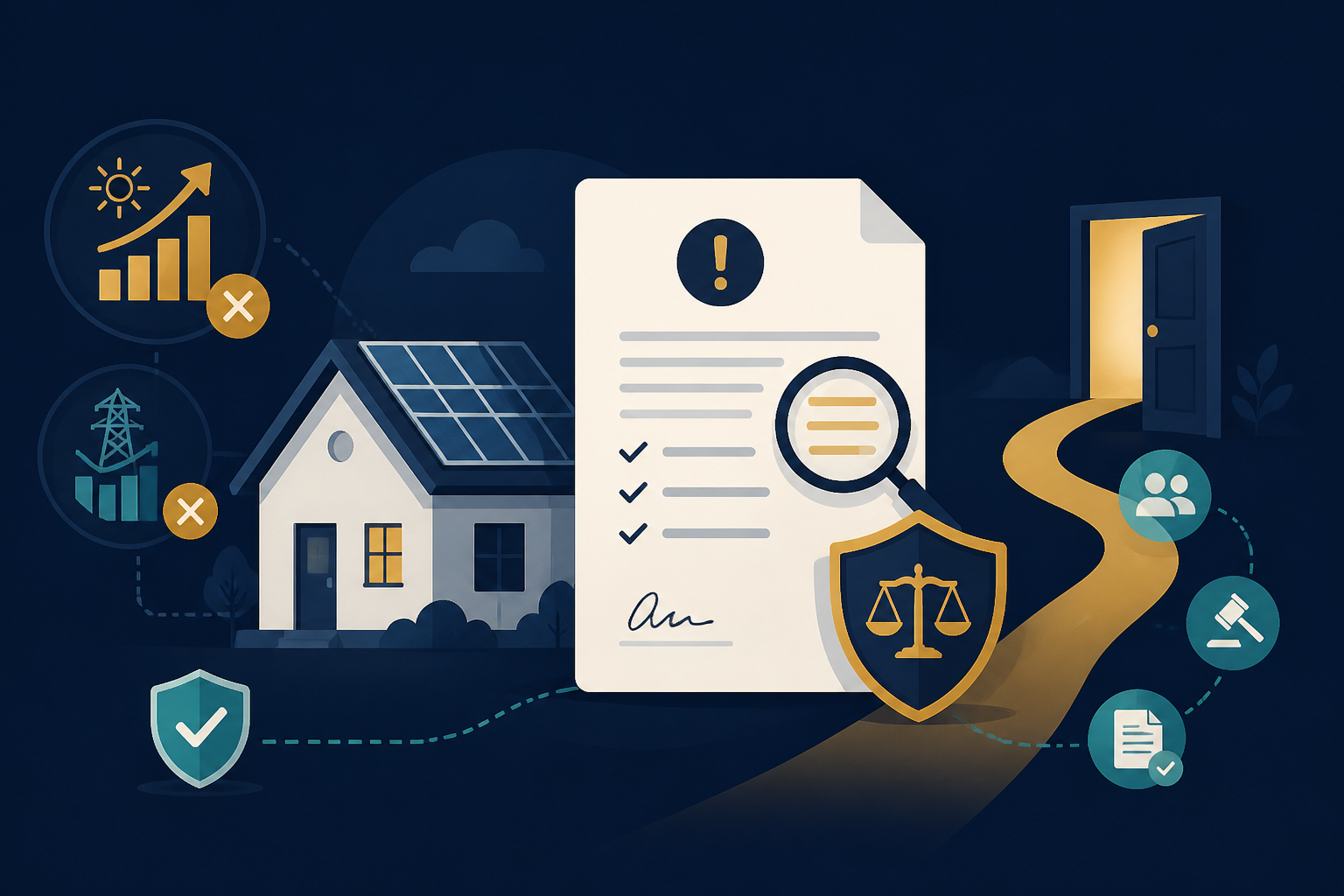
Discover the legal steps and consumer protections available to homeowners who were misled by solar sales representatives regarding tax credits and utility savings.
What to Do When a Solar Company Lied to Me About a Contract
Solar energy is one of the best investments a homeowner can make, but the industry is currently facing a surge in high-pressure sales tactics. Many homeowners find themselves signing a 25-year agreement based on verbal promises that never show up in the fine print.
If you are currently thinking, "the solar company lied to me about my contract," you are not alone. Whether it was a promised tax rebate that turned out to be a credit you don't qualify for, or a guarantee of $0 electricity bills that never materialized, there are legal frameworks designed to protect you. This guide outlines how to identify misrepresentation and the steps to take to void an unfair agreement.
Common Types of Solar Misrepresentation
In the solar industry, misrepresentation usually falls into three categories: financial incentives, energy performance, and the structure of the agreement.
One of the most frequent complaints involves the Federal Investment Tax Credit (ITC). Sales reps often frame the 30% tax credit as a "check in the mail" or a guaranteed rebate. In reality, the ITC is a non-refundable tax credit; if you don't owe enough in federal taxes, you cannot use the full value.
Another common issue is the "guaranteed savings" trap. A rep might claim your utility bill will vanish, ignoring the fact that most utilities charge a fixed monthly connection fee (typically $10–$30) regardless of how much solar power you produce. If the solar company lied to me about these fixed costs, the financial math of the entire deal changes.
The "Integration Clause": Why the Fine Print Differs
Most solar contracts contain an "Integration Clause" or "Merger Clause." This legal snippet essentially says: "Only what is written in this document counts; verbal promises made by the salesperson are void."
Unscrupulous companies use this to shield themselves. They may verbally promise you a free roof repair or a $2,000 sign-on bonus, but if those items aren't listed in the written contract, the company isn't technically obligated to provide them. However, if the salesperson used fraudulent claims to induce you into signing (fraudulent inducement), the integration clause may not protect them in a court of law.
Your Right to Cancel (The Cooling-Off Rule)
Before panicking, check your calendar. Under the Federal Trade Commission’s (FTC) Cooling-Off Rule, you have a legal right to cancel a contract for $25 or more within three business days if the sale took place at your home or a location that is not the seller’s permanent place of business.
Some states offer even longer protections. For example, in California, homeowners over 65 may have up to five business days to cancel certain home improvement contracts. If you are within this window, send a Notice of Cancellation via certified mail immediately. You do not need to provide a reason or prove that the solar company lied to me during this period.
Gathering Evidence of Fraud or Deceit
If the cancellation window has passed, you must build a case for misrepresentation. Collect the following:
- The Sales Presentation: Did they use a digital tablet or a paper brochure? Many deceptive companies use misleading charts that show utility rates rising by 10% annually when the historical average is closer to 2-4%.
- Email and Text Logs: Any written confirmation of a promise that contradicts the contract is gold in a consumer protection case.
- Utility Bills: Compare your post-install bills to the "estimated savings" sheet provided during the sale.
If the solar company lied to me about the physical equipment—such as promising American-made panels but installing cheaper alternatives—take photos of the serial numbers and spec sheets on the back of the panels or the inverter.
Escalation: AG Complaints and Arbitration
If the company refuses to let you out of the contract, your next step is filing a formal complaint with your State Attorney General’s office. Most states have a dedicated consumer protection division that investigates solar scams.
Additionally, check your contract for a "Mandatory Arbitration Clause." Many solar agreements prevent you from suing in open court, requiring you to settle disputes through a private arbitrator. While this sounds daunting, an arbitrator can still void a contract if clear evidence of fraud or material misrepresentation is presented.
Bottom Line
A solar contract is a significant long-term financial commitment. If you feel the solar company lied to me to secure a signature, do not simply stop making payments, as this can ruin your credit score. Instead, document the discrepancies, invoke your state’s consumer protection laws, and consult with a consumer rights attorney to move toward a formal rescission of the contract.