Solar Dealer Fees vs. Interest Rates: The Cost of Financing
Think you're getting a steal with a 2.99% solar loan? You might be paying a 30% hidden markup upfront. Here is how to spot solar dealer fees.
Solar Dealer Fees vs. Interest Rates: The Hidden Cost of Financing
If you have been shopping for solar panels, you have likely seen some incredibly attractive interest rates. Offers of 1.99%, 2.99%, or 3.99% APR are common in the industry. However, in an era where the federal funds rate is significantly higher, these numbers seem too good to be true because, quite often, they are.
To offer these "teaser" rates, solar lenders charge a massive upfront fee to the solar contractor, which is then passed directly to you in the total project price. This is known as a dealer fee. Understanding the solar loan dealer fee calculation is essential for any homeowner who wants to avoid overpaying by thousands of dollars.
What is a Solar Dealer Fee?
A solar dealer fee is an upfront surcharge that a solar lender charges a contractor for the privilege of offering a low-interest loan to a customer. Rather than paying the interest over 20 years, the lender collects a large portion of that interest immediately by adding it to the principal balance of the loan.
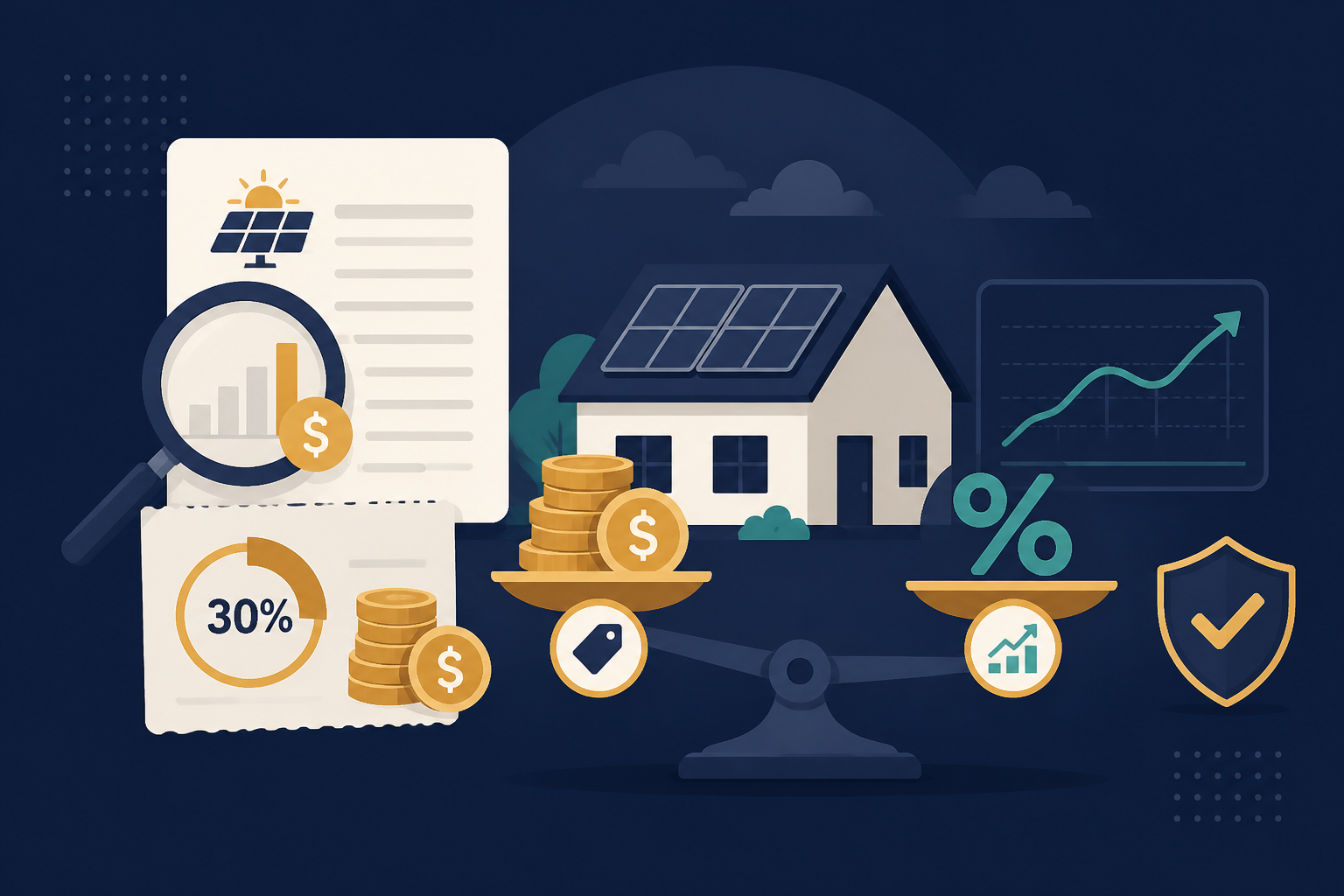
Currently, dealer fees for ultra-low interest rates can range anywhere from 20% to 35% of the total project cost. For example, if your solar system actually costs $30,000, a lender might add a 30% dealer fee, bringing your total financed amount to $39,000 before a single kilowatt of power is generated.
How the Solar Loan Dealer Fee Calculation Works
Lenders do not usually list the dealer fee as a line item on your contract. Instead, it is baked into the "Cash Price" presented by the installer. To perform a basic solar loan dealer fee calculation, you must compare the cash price of the system with the financed price.
Here is a typical scenario:
- Cash Price Offer: $25,000
- Financed Price (2.99% APR): $32,500
- The Difference: $7,500 (The Dealer Fee)
In this case, you are effectively paying $7,500 upfront to "buy down" the interest rate. While your monthly payment might look lower, you have instantly wiped out a massive chunk of your home equity and increased your total debt obligation.
The Low-Interest Trap: Paying More for Less
The primary danger of these fees is how they affect your return on investment (ROI). Because the solar loan dealer fee calculation adds to the total principal, you are also paying interest on the fee itself.
Furthermore, if you decide to sell your home or pay off the loan early (for example, in year 5), you are still responsible for the full $32,500 balance. In a traditional high-interest loan with no dealer fee, your principal would be much lower, allowing for a cheaper buyout. By taking the "low interest" route, you have locked in a high price tag that cannot be negotiated down later.
How to Spot Hidden Fees in Your Disclosure Statement
When you receive your Truth in Lending Act (TILA) disclosure, the federal government requires lenders to be transparent about costs, but they still manage to hide dealer fees in plain sight. Here is how to find them:
- Check the "Amount Financed": Compare this number to the verbal quote for the system's value. If the amount financed is significantly higher than the equipment and labor value, that is the fee.
- Request a Cash Price: Always ask the salesperson for the "cash price" vs. the "financed price." If they hesitate or tell you the price is the same, they are likely baking a high fee into the baseline price.
- Review the Itemized Proposal: Look for terms like "Origination Fee" or "Lender Fee," though most installers will simply inflate the "Cost Per Watt."
If the cost per watt jumps from $3.00 (cash) to $4.20 (financed), your solar loan dealer fee calculation shows a 40% markup.
Strategy: Comparing High-Interest vs. High-Fee Loans
Is it ever worth it to pay the fee? Occasionally, yes. If you plan on staying in the home for the full 25-year term and never paying the loan off early, the lower monthly payment of a 3.99% APR (with a fee) might save you more total cash than a 9% APR (with no fee).
However, for most homeowners, a "No-Dealer-Fee" loan or a Credit Union solar loan is a better deal. These typically have higher interest rates (matching current market trends) but $0 in hidden markups. This reflects a more honest solar loan dealer fee calculation where you only pay for the interest you actually use over time.
Bottom Line
Low-interest solar loans are rarely the bargain they appear to be. By understanding the solar loan dealer fee calculation, you can see past the marketing and determine the true cost of your clean energy transition. Always demand a cash price quote, compare it to your financed total, and remember: if the interest rate is lower than what the bank offers for a mortgage, you are likely paying for it upfront in hidden fees.