Solar Loan Payments in Winter: Handling Negative ROI
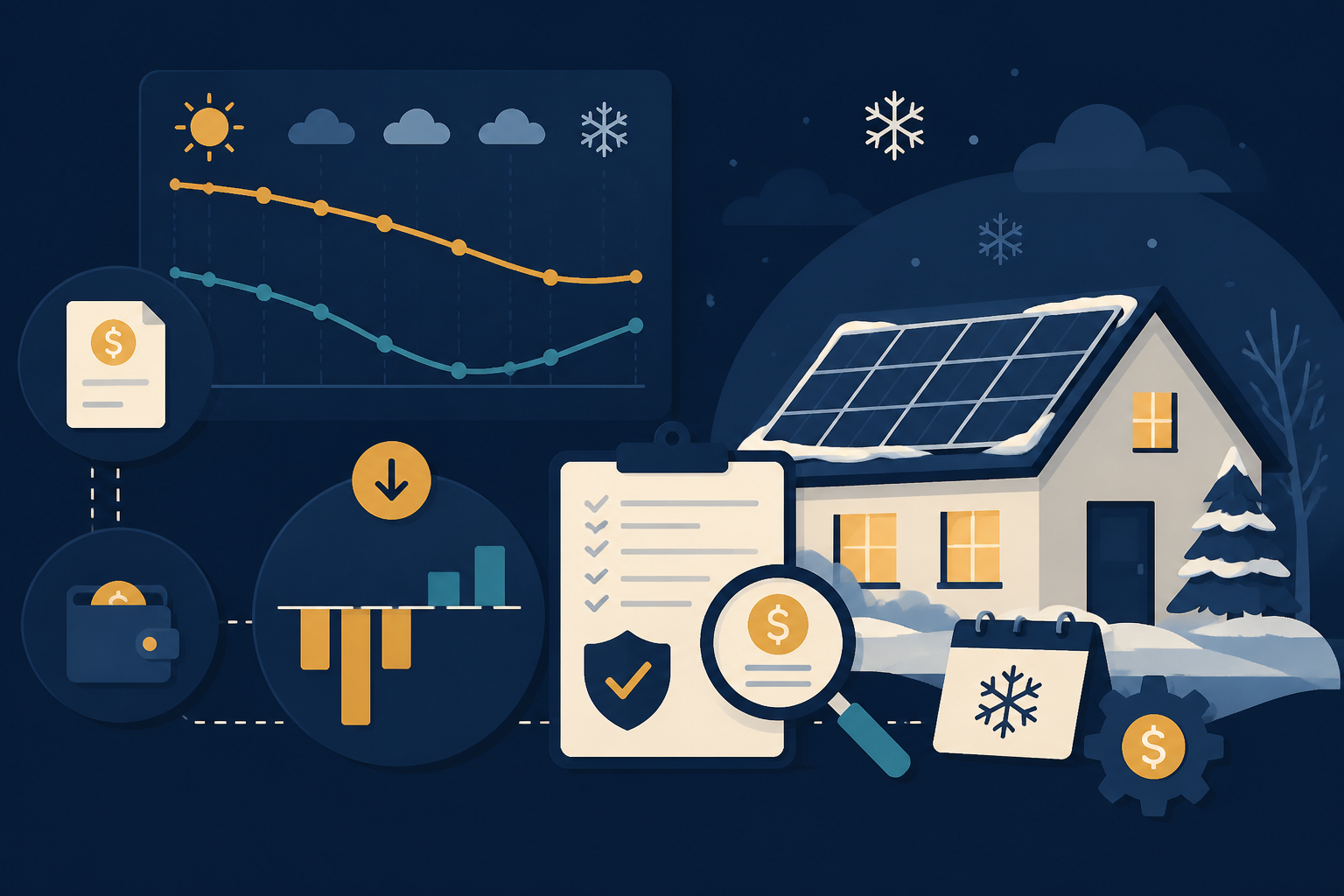
Is your solar loan costing more than your utility bill this winter? Learn why seasonal production dips happen and how to manage the temporary negative ROI.
For many homeowners, the first winter with a solar energy system brings a moment of "sticker shock." In the summer, the meter spins backward, the utility bill is near zero, and the solar loan payment feels like a bargain. But when December hits, production plunges while the loan payment remains fixed.
If you find yourself paying a $150 monthly loan plus a $100 utility bill because of short, cloudy days, you are experiencing a temporary negative ROI. Understanding why solar loan payments in winter feel so heavy—and how to audit your financing contract to handle them—is essential for long-term financial peace of mind.
Why Solar ROI Flips in the Winter
Solar panels rely on direct sunlight to generate electricity. During the winter solstice in the United States, the sun is lower in the sky and stays out for fewer hours. In regions like the Northeast or Midwest, production can drop by 50% to 70% compared to July peaks.
While your energy production is seasonal, your financing is usually not. Most solar loans are structured with fixed monthly payments. This creates a mismatch:
- Summer: You produce $200 worth of power, pay a $150 loan (+$50 net gain).
- Winter: You produce $40 worth of power, pay a $150 loan (-$110 net loss).
This monthly "deficit" is common, but it can be frustrating if your solar installer didn't clearly explain the concept of annual averaging.
Auditing Your Solar Loan Contract
If your solar loan payments in winter are higher than you anticipated, the first step is to audit your contract. Not all solar loans are created equal, and some have "hidden" escalators or re-amortization requirements.
Look for the "Target Payment" Clause
Most solar loans are designed with a low initial payment for the first 12 to 18 months. This is based on the assumption that you will receive the 30% Federal Investment Tax Credit (ITC) and apply it directly to the loan principal. If you don't pay down the loan with that tax credit, your monthly payment will "re-amortize" and jump significantly—often right around the time winter bills are highest.
Check for Escalator Clauses
While more common in Power Purchase Agreements (PPAs) and leases, some loans have annual interest rate adjustments. Ensure your payment hasn't increased due to a scheduled hike rather than just a seasonal production dip.
Managing the Cash Flow Gap
To survive the winter months without feeling the pinch, you need to treat your solar savings like a seasonal business. Here are three strategies to manage your cash flow:
- Bank Your Summer Savings: If your utility offers Net Energy Metering (NEM), you likely earned credits during the summer. Those credits act as a buffer. If you don't have NEM, you should manually set aside the "savings" you made in July to cover the higher utility bills in January.
- Verify System Health: Don't just assume low production is due to the weather. Check your monitoring app (like Enphase or SolarEdge). If one string of panels is down or covered in thick snow for weeks, your negative ROI will be much worse than necessary.
- Levelized Billing: Some utilities allow you to enroll in "budget billing" or levelized billing for the residual portion of your power bill. This smooths out the winter spikes, making it easier to manage alongside your fixed loan payment.
The Role of Net Metering (NEM)
Your experience with solar loan payments in winter depends heavily on your state's Net Metering policy.
In a "NEM 1.0" or "NEM 2.0" environment (like older contracts in California or many East Coast states), your summer overproduction is credited at the full retail rate. This means your summer "profits" directly offset your winter "losses" on a 1:1 basis. However, in newer "NEM 3.0" or Net Billing landscapes, the utility pays you much less for the power you export. In these cases, your winter bills will naturally be higher because you can't "bank" the full value of summer sun as effectively.
Is Negative ROI a Sign of a Bad Deal?
Not necessarily. Solar is a 25-year investment. A few months of solar loan payments in winter exceeding your utility savings doesn't mean the system is a failure. The goal of solar is Annual Net Savings.
To calculate your true ROI, add up your total loan payments for the year and your total utility bills for the year. Compare that to what you would have paid without solar (accounting for utility rate hikes, which average 4-5% annually). If the annual total with solar is lower, the system is doing its job, even if January feels like a struggle.
The Bottom Line
Seeing your solar loan payments in winter outpace your energy savings is a common part of the solar ownership cycle. By auditing your loan contract for re-amortization triggers and banking your summer credits, you can weather the dark months. Remember: solar is a marathon, not a sprint. The high production of June is just a few months away.